|
|
Sergeant Pilot James D'Arcy Lees Graham
|
On the 10th February 1942, 24 years old
Sergeant Pilot James D’Arcy Lees Graham
R77959 from Carstairs Alberta a member
of the Royal Canadian Airforce based at
RAF Usworth, was tragically killed in a
flying accident, crash landing into
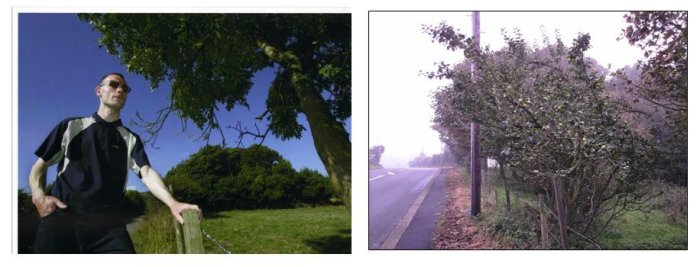
what was once an orchard opposite the
High Marley Hill Radio Mast.
Thanks to the painstaking research
carried out by historian Philip Smith
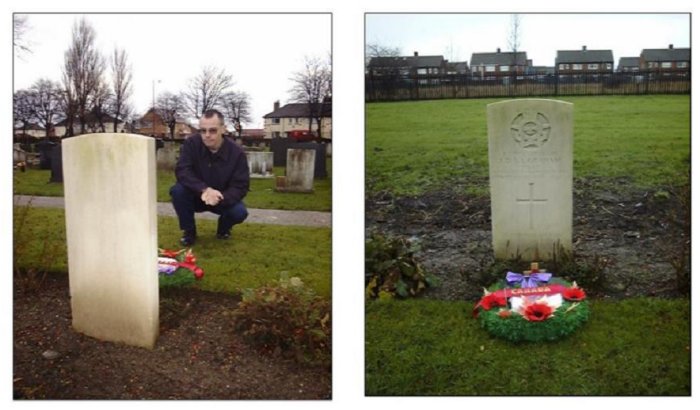
(pictured above at the crash scene) who
specialises in aviation and war
crashes, the full details of the
tragedy came to light. Thirty six
years old Philip of Whickham has always
been interested in aviation and crashed
aircraft, believing that the pilots
should not be forgotten.
The Air Ministry Crash Card records
that on the 10th February 1942 a single
seater fighter aircraft Hawker
Hurricane MK1 serial number P3664 flew
into high ground in a squall, the
weather deteriorated and the aircraft
dived out of low cloud into a snow
squall and failed to pull out of the
dive.
Email: Sunniside Local History Society |
|
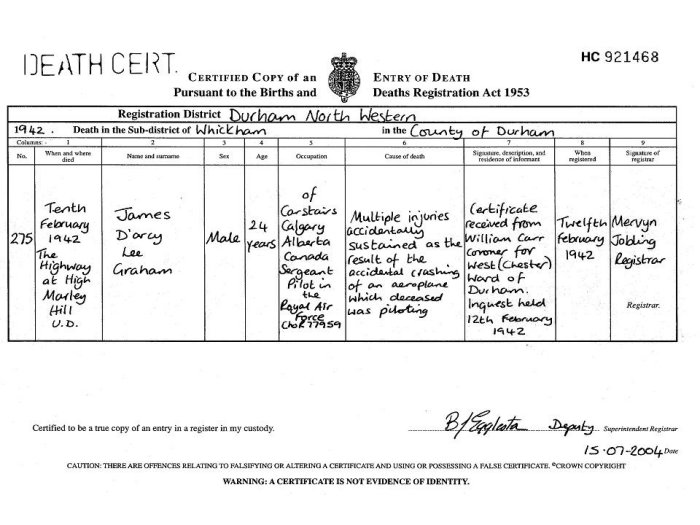
The death certificate obtained by Philip in July 2007 confirms that James D’Arcy Lees died because of multiple injuries sustained as a result of the aeroplane crash.
Continuing his enquiries, Philip received the following letter In January 2007 from the Royal Canadian Legion Branch of Carstairs Alberta which gives some personal details and an insight into the life of James.
Dear Mr Smith
Re: James D'Arcy Lees Graham
You should be commended for putting so much effort into the memory of a war veteran. We are very impressed with your efforts.
I apologize for the time it has taken to respond to your letter. But, I have been able to find some information for you.
D'Arcy was the name he went by. He was tall, red headed and a nice guy. D'Arcy was an only child and his classmates found it unusual that he had three given names instead of the customary two. His father, James Graham, was a WW1 vet and his parents came from England. After D'Arcy was killed, they moved away.
Unfortunately, we don't know where the Grahams moved to or who their relatives were. The locals that went to school with D'Arcy are now well in to their eighties. They are trying to come up with more information. One knows he has a scrap book with D'Arcy's picture and story. I am also having a story placed in the local paper.
This is all I can tell you for now but I thought you should have it and know that I am pursuing this story. I will follow up with more information as soon as possible.
Sincerely,
Bev Stevenson
Royal Canadian Legion Branch
|
|
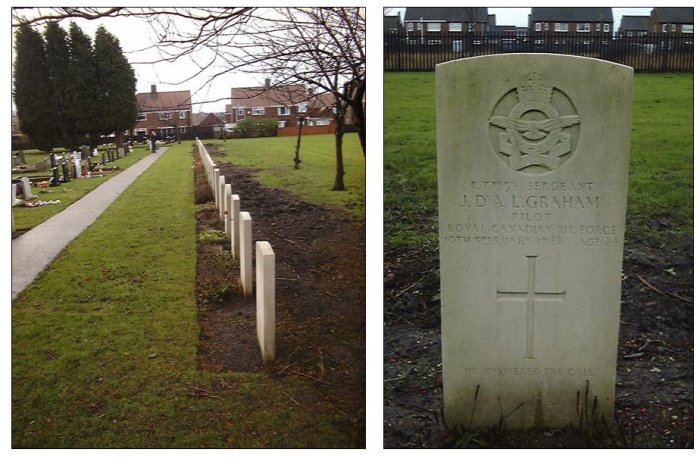
James D'Arcy Lees Graham is interred at St Margaret’s Church Cemetery Castletown Sunderland
Obviously touched by the death of the pilot and aware, that had James D’Arcy Lees Graham not ‘answered the call’ and volunteered to help defend our country, he would not have died in such tragic circumstances. Philip resolved to honour him in some away and create a permanent memorial in order that James would be remembered by our community.
|
|
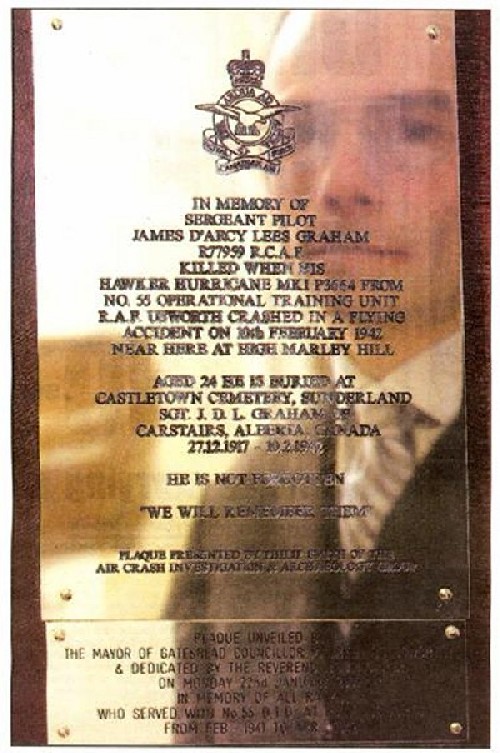
Philip commissioned a specially engraved brass plaque and following an enormous amount of planning and preparation, sixty four years on Sergeant Pilot James D’Arcy Lees Graham was remembered at a special event held in the Marley Hill Community Centre (formerly the Miners Welfare Hall) on Monday 22nd January 2007.
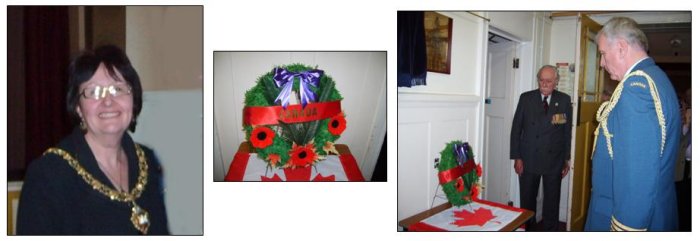
In attendance were the Mayor of Gateshead Maureen Goldsworthy and her Consort Robert, the Reverend Bob Hopper, Colonel Daniel B. Edgar of the Canadian Air Force, Councillors Marilyn & Alan Ord, Tom Hughes a former spitfire pilot during WW2, and invited guests representing the Community. Philip expressed his gratitude for the valuable help and support of Alan & Marilyn Ord The Trustees of the Community Centre.
(The above photograph was published in the Evening Chronicle)
|
|
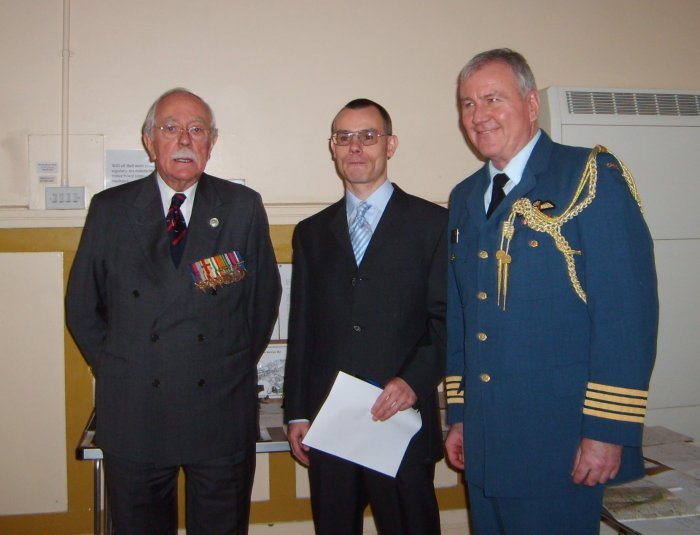
In a moving ceremony the plaque was unveiled by Mayor Maureen Goldsworthy and dedicated by the Reverend Hopper. Colonel Edgar (pictured above with Tom Hughes) placed a wreath on behalf of the Canadian people.
Colonel Edgar had flown in from London that morning to attend the ceremony and spoke warmly of his appreciation, that thanks to Philip Smith, Sergeant Graham had not been forgotten..
|
|
Following the ceremony guests were invited to meet in the hall and take light refreshments.
Philip, pictured above with Tom Hughes and Colonel Edgar, had organized the entire event and was delighted that everything went as planned.
|
|
Thomas Bartley Hughes
23rd November 1921 - 31st December 2010
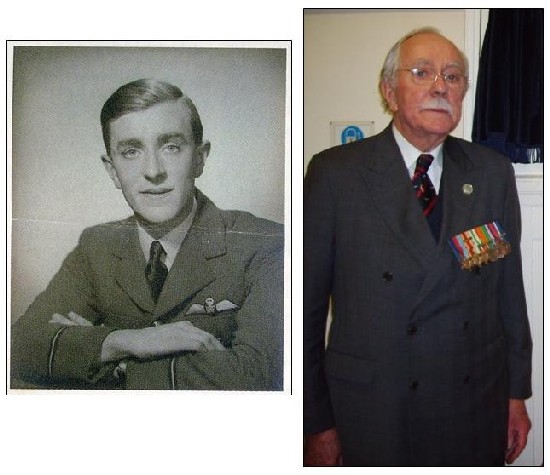
Born in 1922 in Rugby, Warwickshire, Tom Hughes (pictured above during WW2 and in February 2007) attended the town's famous school as a day pupil. Aged 18 in 1940, he joined the RAF Volunteer Reserve as a pilot and started his flying training on DH Tiger Moths at 7 Elementary Flying Training School at Desford, Leics, that October. There he flew in a mix of civilian and service-registered machines for 38 hours before moving on to 8 Flying Training School at Montrose, Scotland, to fly Miles Masters for a further 72 hours.
Assessed as 'above average', Tom was posted to the Central Flying School at Upavon, Wilts, joining 82 (23 War) Flying Instructors Course on Airspeed Oxfords and Avro Tutors. After a further 92 hours, and a total of just 202 hours flying, he qualified as a Flying Instructor on June 15,1941. Tom joined 11 Service Flying Training School at Shawbury, Shropshire, in June 1941, flying Oxfords. That October he was posted to the College Flying Training School at Cranwell, Lincs, still flying the Oxford, but in December he moved to the Advanced Flying Unit and started flying Masters as well. In March 1942, he moved to 60 Operational Training Unit at East Fortune, Scotland, and started to fly a wider range of types, including the Bristol Blenheim and Bisley, Beaufighter II, DH Dominie, Fairey Battle and Miles Magister.
In September, he moved to 58 OTU at Grangemouth, Scotland, now with over 900 hours on nine types. Here, after a few trips in a Master, he first flew a Supermarine Spitfire and gained 66 hours on Mkls and Ils. Attaching himself to 6fl (West Lancashire) Squadron at Biggin Hill, Kent, he also managed a couple of trips in a Mk.IX before setting off to Gibraltar to join the Spitfire Erection Party. As an experienced pilot and instructor - albeit with limited time on type - Tom set about air-testing newly-assembled Spitfires and helped to ferry them across the Mediterranean to Maison Blanche and on to Souk-el-Arba, both in Algeria. Tom was posted to 72 Squadron on January 28,1943, and his exploits are contained in the main feature. No.72 Squadron was based at Pachino in Sicily, flying Spitfire IXs in August 1943. On August 19 opposition in Sicily ended and in September Tom was posted to 43 Squadron as commander of'A' Flight, his new unit moving to Falcone, Italy.
On December 18,1943 his luck finally ran out when he was shot down just north of the monastery at Monte Cassino. His Spitfire was brought down by machine-gun fire when he was making a strafing attack. It caught fire and he was too low to bale out. His trousers were burned off his legs below the knees and he hit his head during the crash-landing and remembers little of the crash. His burns were treated by the Germans and then was moved, stretcher-bound from Italy to Germany. He was 'exchanged' in a 1 for 3 scheme with German prisoners, having been assessed by a panel of doctors as requiring repatriation. He then spent four days crossing Germany by train, worried sick that the RAF would find them and shoot them up. From Switzerland he was taken to Marseilles, where he boarded the liner Arundel Castle and sailed past Gibraltar to Liverpool and home, where Tom's father was waiting to greet him on the quayside.
After the war Tom went to Cambridge and did his Mechanical Sciences Tripos before working in design offices for AEI, Hotpoint, Pilkington and Ronson - later becoming a freelance consultant engineer. He did not leave aviation completely, becoming a leading member of the Cambridge University Gliding Club until 1951. He has been an active member of the 72 Squadron Association for many years.
In April 1919 American Leslie Irvin hurled himself deliberately out of an aircraft. He was testing the world's first self-deployable parachute. He formed the Irvin Air Chute company (now Irvin Aerospace) Leslie decided that anyone who used an Irvin parachute to leave a stricken aircraft and therefore save their life should become a member of a club. His parachutes used a lot of silk and he decided that the caterpillar was an ideal emblem. In 1922, he decided to award a gold tie pie to club members - getting on for 100,000 have been issued. Leslie Irvin also gave the world the flying jacket that also carries his name
Tom Hughes joined the Caterpillar Club on August 15th 1943. The entry qualification is unusual; all members have to save their lives by parachute. There is no clubhouse but the badge of membership is a little golden Caterpillar with eyes of amethyst.
Sadly Tom died on the 31st December 2010 aged 89 years. He was loved and respected by everyone who knew him and will always be remembered.
|
|
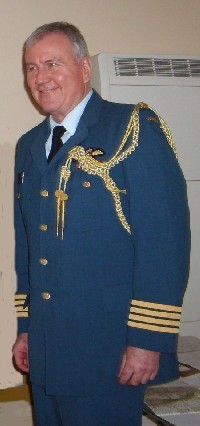
COLONEL DANIEL B. EDGAR, CD
Colonel Edgar joined the Canadian Forces in 1974 after completion of an Honours B.A. at McMaster University in Hamilton, Ontario. He received his pilot wings on the CT-114 Tutor at CFB Moose Jaw in 1976. Following this Col Edgar underwent helicopter conversion training in Portage La Prairie, Manitoba and advanced training in Gagetown, New Brunswick.
In 1977 he was posted to 408 Squadron Edmonton where he held the positions of LOH Deputy Flight Commander and CH-1 36 Kiowa Standards Officer. Col Edgar attended Canadian Forces Staff School in 1980. In 1981, he was posted to 450 Squadron Ottawa and converted to the CH-147 Chinook helicopter. During this tour of duty he completed the Canadian Land Forces Staff College at Kingston. He was subsequently selected in 1984 as the first Canadian exchange officer to fly the RAF HC1 Chinook with 7 Squadron at RAF Odiham, Hampshire. As exchange officer he completed a four month tour of duty with 78 Squadron in the Falklands Islands in 1986. In 1987, he was posted as executive assistant to the Deputy Commander of Air Command in Winnipeg, Manitoba.
In 1989, he attended Canadian Forces Command and Staff College in Toronto followed by a tour of duty with 444 Squadron in Lahr, Germany flying the CH-1 36 Kiowa helicopter. In 1992, following the closure of 444 Squadron, Col Edgar was transferred back to 408 Squadron Edmonton as Deputy Commanding Officer. During the period from March to June 1995, he assumed command of 408 Tac Hel Squadron. In 1995 he was appointed Commandant of the Canadian Forces School of Survival and Rescue. In July 1996, he was appointed as Commandant 3 Canadian Forces Flying Training School in Portage La Prairie, Manitoba. Following this, he was assigned as Ex Coord at 1 CAD HQ Winnipeg in 1999. In June 2000 he was promoted to his current rank and assigned as Al Training in 1 CAD HQ. In August 2003 he was appointed Chief of Staff 1 CAD/CANR HQ. And in August 2004, Air Force Adviser, Canadian Defence Liaison Staff (London).
An aviator with more than 4700 hours of Military flying., he is married to the former Wendy German of Alberta. They have two daughters, Courtney and Kathleen.
|
|
The day following the unveiling of the plaque, Philip took the Canadian wreath to place on the grave of Sergeant Graham. Words on the plaque ‘He Is Not Forgotten, We Will Remember Him’ were very appropriate on such a sad occasion.
The Sunniside and District Local History wish to congratulate Philip Smith for his efforts and tenacity in ensuring that the death of Sergeant Graham would be remembered by the community at large. We were proud to be invited to attend such an occasion and pay our respects.
SHOULD ANYONE HAVE ANY INFORMATION REGARDING THE WHEREABOUTS OF THE FAMILY OF SERGEANT GRAHAM, WE WOULD BE DELIGHTED TO HEAR FROM YOU. PLEASE CONTACT US BY OUR E-MAIL ADDRESS.
|
|
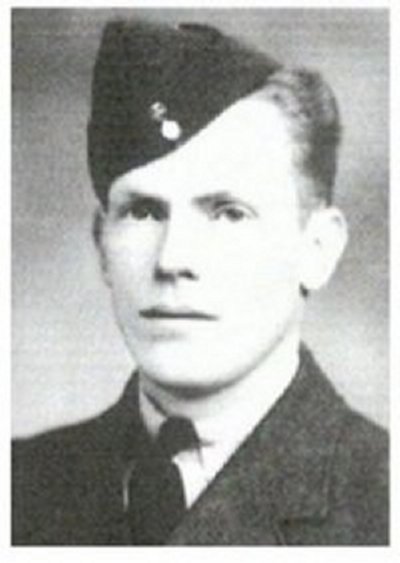
ON FEBRUARY 1st 2008 PHILIP RECEIVED A PHOTOGRAPH OF D’ARCY FROM VICTORIA SCHOOL ARCHIVIST JACK CALKINS EDMONTON CANADA.
|
|
We received the following e-mail from who Len Hinds who formerly lived at Marley Hill:
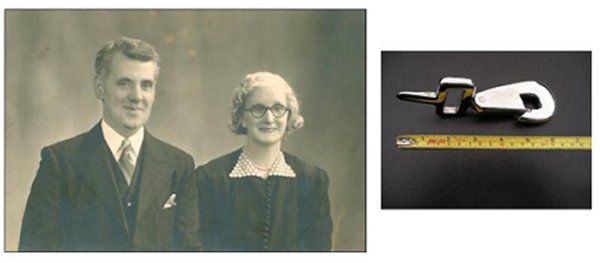
I visited your excellent web site today, for the first time and read with great interest the account of the Marley Hill air crash. My Grandmother (pictured above) told me, that she was called to the crash site to attend to the pilot as she had been a nurse, she removed his parachute harness to attend to him and I was given one of the parachute clips (which had become detached and pictured above) as a boy, which I still have to this day.
My family the ‘Hinds’ had lived in Marley Hill for four generations. My Great-Grandfather (Peter Hinds) was the first, he was born at Alston but moved to the street of houses known as The Hole in the valley at Marley Hill in the late 1800’s and worked at Marley Hill colliery. One of his sons James Hinds was killed in the First World War he is named on the Church War Memorial
My Grandparents Edward and Isabella Hinds (pictured above) lived at 5 Church Street they had sons John (Jack ) Edward (Eddie) and Dennis.
My Grandmother, Isabella McGowan was born at Lintz Colliery Burnopfield in 1888.
Her father, John McGowan came from Ireland and was a miner and also the sexton of Burnopfield Church, his grave is facing the entrance door into the Church.
My parents Edward and Olive Hinds first lived at 40 Church Street where I was Born, my sister was Elaine, they moved to 27 Church Street later.
_____________________________
We are grateful to Len for trusting us with his photographs and for giving us more information on the events regarding the aircraft tragedy and the background information about his family.
____________________________________
|
|
|
|
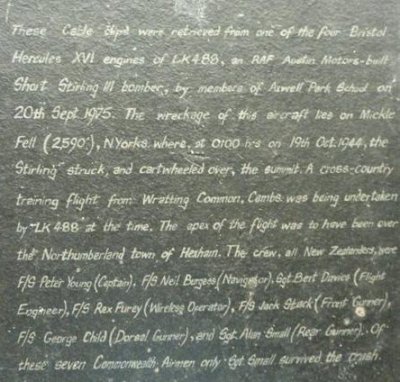
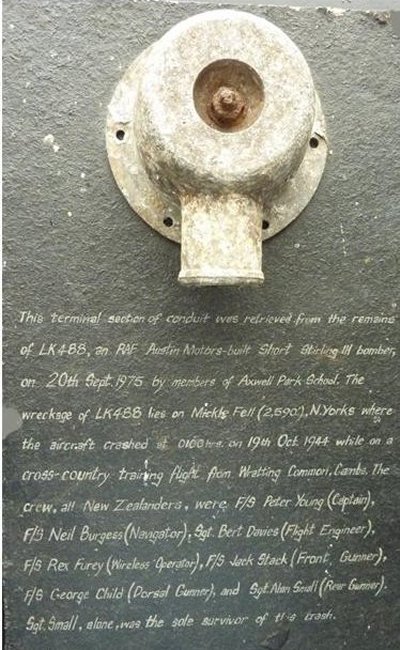
These plaques were made and dedicated to the deaths of the air crew following an air crash in 1944 on Mickle Fell North Yorks
|
|
|
|
|
|